Paola Delarosa-Lloret
M.S. Instructional Design, Development & Evaluation

Social Learning
Social Learning Theories

Come with me to learn more!


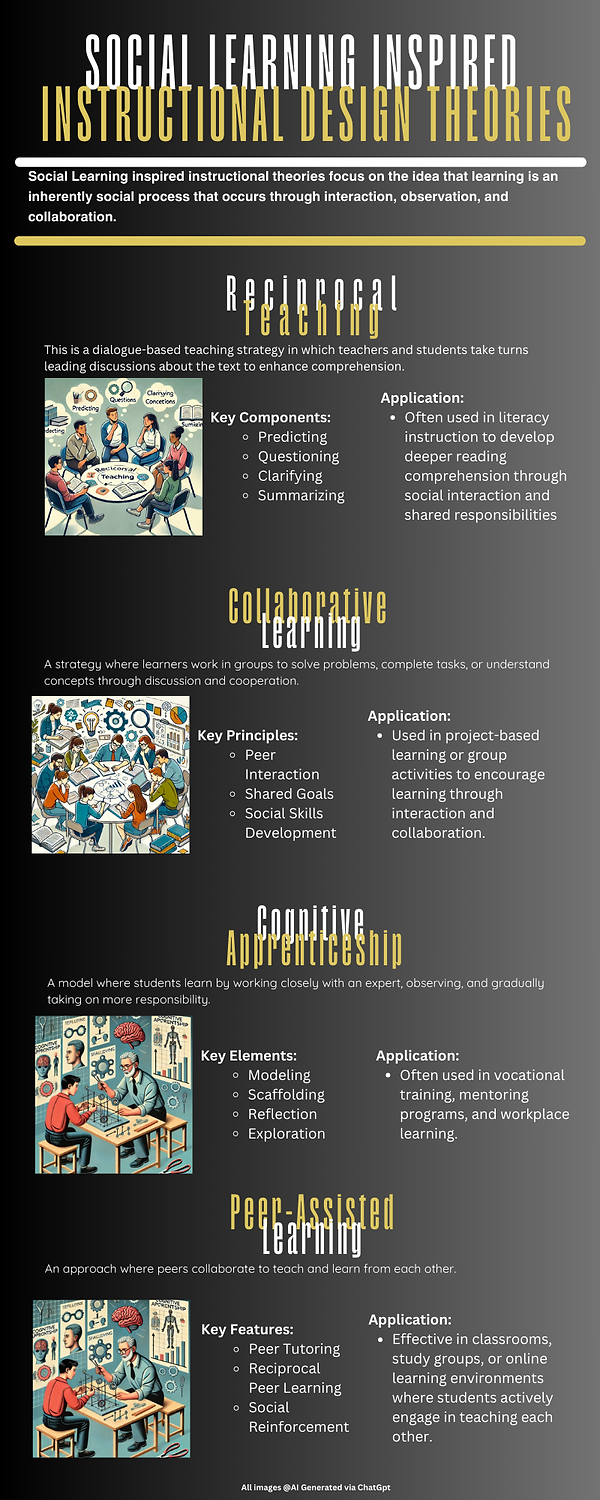
Social Learning Inspired Instructional Design Theories
Come with me to learn more!
Social Learning - Learning Scenario

Social Learning - Observational Checklist


Reflection
Social Learning Theory stood out to me because of its focus on learning through observation, imitation, and social interaction. Unlike behaviorism, which emphasizes direct reinforcement, or cognitivism, which centers on mental processes, social learning highlights the role of social contexts in shaping behavior. Albert Bandura’s concept of observational learning shows how people learn by watching others and modeling their behaviors, making it highly relevant in environments where collaboration and peer interaction are key to learning.
One of the most impactful aspects of Social Learning Theory is the concept of modeling. Learners don’t just rely on their own experiences but also observe the actions and outcomes of others. This idea of vicarious reinforcement can be powerful in classrooms, where students are motivated by seeing the successes or mistakes of their peers. Instructional strategies like role-playing, peer learning, and group discussions align with this theory by providing opportunities for learners to engage in observation and collaboration, reinforcing social interaction and learning. However, I still question some of the limitations of Social Learning Theory, particularly regarding individual cognitive processes. While the theory emphasizes social contexts, it may not fully explain how learners internalize observed behaviors or develop deeper understanding independently. In this regard, combining Social Learning with Cognitivism or Constructivism might offer a more comprehensive approach, as these theories address how individuals process and make sense of information independently.
Exploring Social Learning Theory has broadened my perspective on the importance of social interaction in learning. I now recognize how group discussions, peer assessments, and collaborative projects create richer learning environments by allowing students to learn from each other. At the same time, I realize the need for a balanced approach that incorporates cognitive and constructivist principles to address both social learning and individual understanding. This integrated view enables me to design instruction that promotes social engagement and fosters more profound knowledge and personal growth.